Brass CNC Turned Components Manufacturers for High‑Speed Threading
Date:2026-08-12Article editor:Starting Point PrecisionViews:188High‑speed threading in brass presents a unique machining challenge. Unlike steel or aluminum, brass (particularly free‑cutting grades like C36000) offers excellent chip breakage and low cutting forces—but its high thermal conductivity and tendency to work‑harden demand optimized tool paths, rigid setups, and specifically calibrated CNC lathes. For manufacturers of precision turned components, mastering high‑speed threading is not an option; it is a competitive necessity.
This article outlines the core technologies, equipment parameters, and process controls that define world‑class brass CNC turned components manufacturers for high‑speed threading, with practical insights drawn from high‑volume production environments.
Achieving consistent thread quality at high spindle speeds (≥5,000 RPM) demands machine tools with exceptional rigidity, thermal stability, and synchronous feed control. Based on our production floor, the following CNC turning machining centers are specifically selected for brass threading applications:
| Equipment Name | Brand & Model | Key Feature for Threading |
| CNC turning machining center | Germany DMG CTX beta 800 | Ultra‑rigid box‑way bed; direct‑drive spindle with 12,000 RPM; ideal for large‑diameter NPT threads |
| CNC turning machining center | Japan TAKISAWA NEX‑108 | High‑torque motor (35 kW); C‑axis indexing with 0.001° resolution; perfect for multi‑start threads |
| CNC turning machining center | China JINAN CK6136 | Cost‑effective for short‑run brass jobs; equipped with manual tailstock for supporting long bars |
In addition to turning centers, supporting equipment ensures tool preparation and quality assurance:
● Slow wire cutting (Japan Seibu M50B, Sodick ALN400Gs) – for manufacturing custom thread‑forming inserts and electrodes.
● Flat profile grinding (China MICCO 350) – for re‑sharpening carbide threading tools with exact flank angles.
● Top inner/outer round grinding (Taiwan Glory GU32‑60NC) – for pre‑machining blank diameters to eliminate run‑out before threading.
All listed machines are integrated with high‑pressure coolant systems (≥70 bar) and through‑spindle cooling, which are mandatory for chip evacuation in internal threading. For a complete view of our capability, refer to the Precision Equipment List on our website.
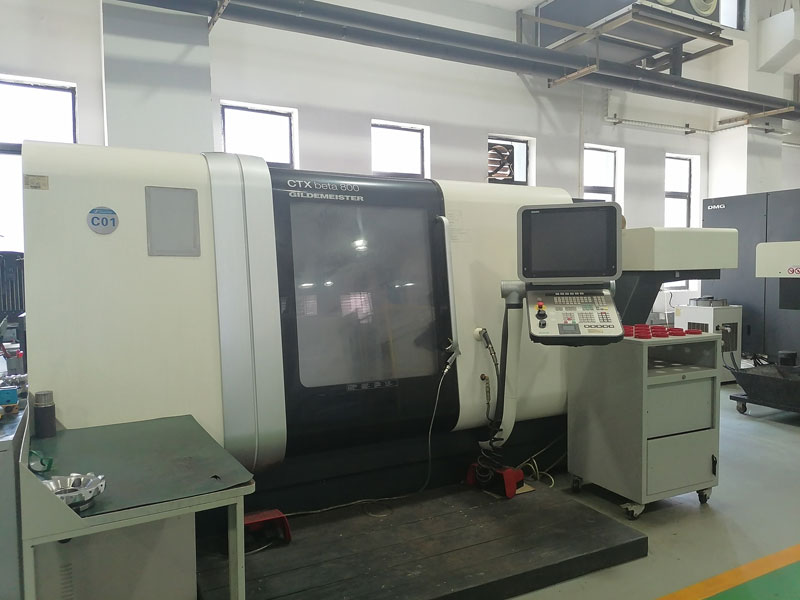
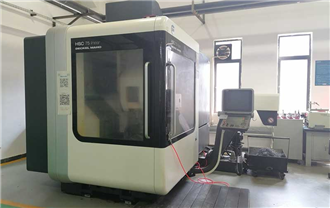
The DMG CTX beta 800 equipped with a live tooling turret
Core Process Parameters for High‑Speed Threading
The table below summarizes typical process windows used by experienced manufacturers for external and internal threading in brass C36000 (1/2” – 2” diameters). Material properties align with ASTM B16 and ISO 426‑1 standards for free‑cutting brass.
| Parameter | External Threading | Internal Threading | Remarks |
| Spindle speed (RPM) | 4,000 – 8,000 | 3,500 – 6,500 | Dependent on bar diameter and machine rigidity |
| Feed rate (mm/rev) | 0.05 – 0.15 | 0.04 – 0.10 | Multiple passes (roughing + finishing) |
| Cutting depth per pass | 0.10 – 0.30 mm | 0.05 – 0.20 mm | Reduced for fine pitch (≥32 TPI) |
| Insert coating | TiN or TiAlN | TiCN (for internal chip evacuation) | Uncoated carbide also works but shorter life |
| Coolant | High‑pressure (≥70 bar) soluble oil | Through‑spindle coolant essential | Improves chip flush and surface finish |
| Threading cycle | G76 (multi‑repetitive) | G92 or G76 with pecking | Pecking breaks long chips in internal bores |
For high‑speed threading, insert geometry is critical. We recommend:
● Full‑profile inserts with chipbreakers designed for non‑ferrous metals – see Sandvik Coromant threading solutions for grade recommendations.
● Positive rake angles (≥15°) to reduce cutting pressure.
● Small nose radii (0.05 – 0.10 mm) for fine pitch threads to minimise burr formation.
Alternative tooling from Kennametal also performs well in brass. Tool life typically reaches 500–800 pieces per edge under proper coolant application, versus 200–300 pieces with generic steel‑grade inserts.
In‑process and post‑process inspections include:
● Laser micrometers for major/minor diameter checks (every 50 pcs)
● Thread go/no‑go gauges (calibrated per ISO 1502)
● Surface roughness testers (target Ra ≤ 1.6 µm)
● Vision systems for flank angle and lead measurement
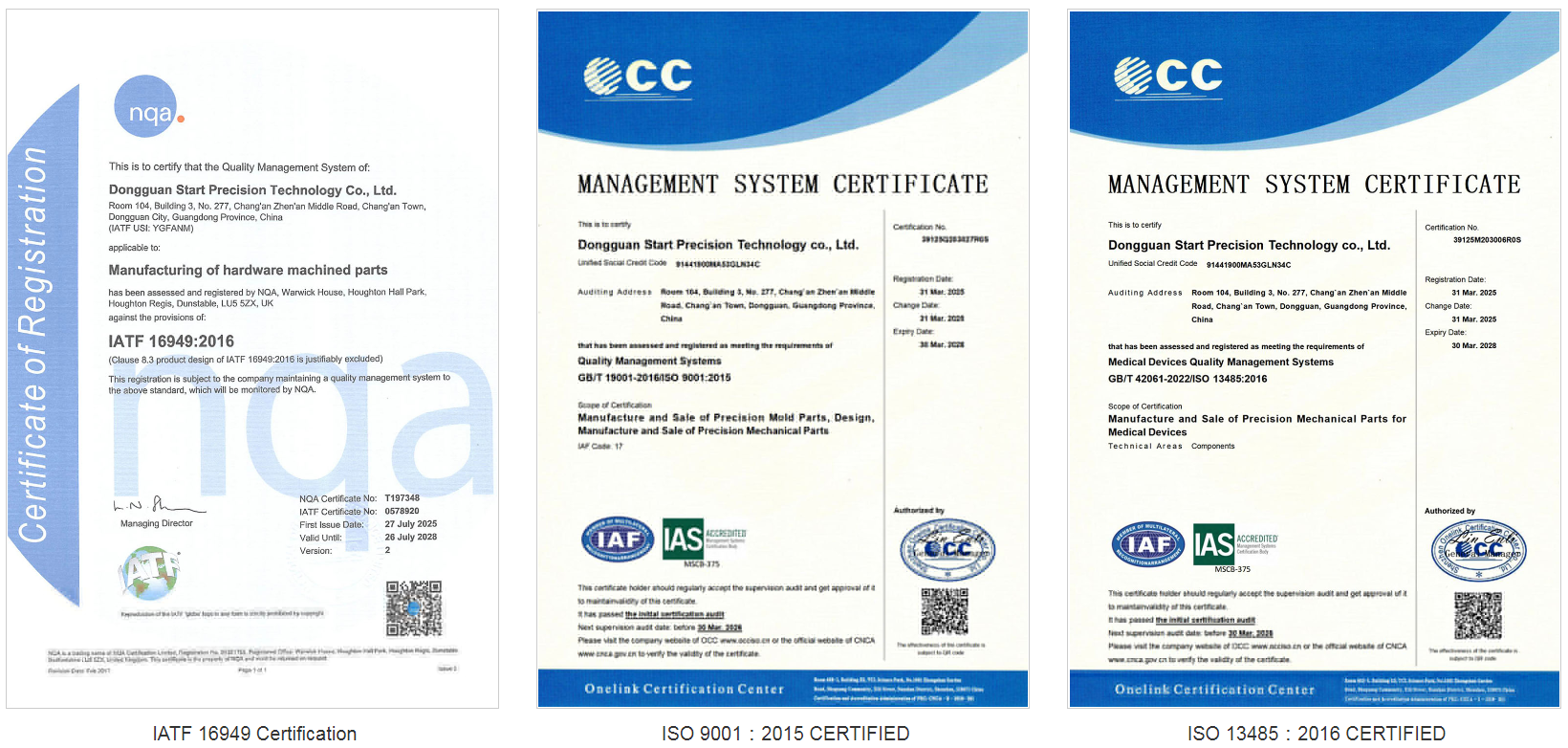
Start Precision is ISO 9001:2015 and IATF 16949 certified, ensuring traceability and statistical process control (SPC) for every batch.
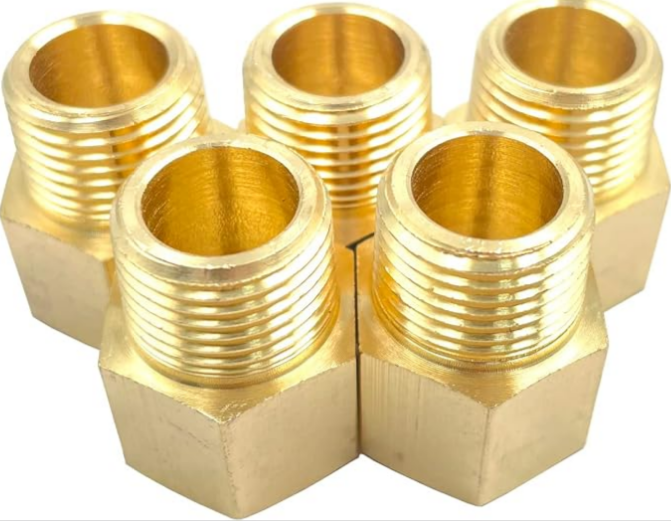
Challenge: A North American hydraulic valve manufacturer required 50,000 brass adapters with a 3/4‑14 NPT thread, needing cycle time under 25 seconds and 100% leak‑test pass rate.
Solution: Using a TAKISAWA NEX‑108 with high‑pressure through‑coolant and a custom PVD‑coated full‑profile insert, we applied a 4‑pass threading routine (rough, semi‑finish, finish, spring pass) at 6,500 RPM. Feed rate was optimized to 0.08 mm/rev for the finish pass, yielding a surface finish of Ra 1.2 µm.
Result: Cycle time reduced to 22 seconds, tool life exceeded 900 parts per edge, and the first‑pass yield reached 99.7%. The customer reported zero leakage in hydrostatic testing and awarded a 3‑year contract.
● Use constant surface speed (CSS) to maintain consistent chip thickness as the tool approaches the shoulder.
● Apply a spring pass (zero depth cut) after the final threading pass to correct any elastic tool deflection.
● Monitor spindle load – a sudden increase indicates insert wear or chip jamming.
● For multi‑start threads, program C‑axis indexing with absolute positioning to avoid cumulative pitch errors.
Selecting a brass CNC turned components manufacturer for high‑speed threading means evaluating not only machine specifications but also process know‑how, tooling strategies, and a rigorous quality culture. The right partner will deliver threads that meet functional, aesthetic, and cost targets – consistently.
At Start Precision, we combine advanced equipment with decades of threading expertise. Our shop floor features live monitoring of thermal drift, automated tool‑wear compensation, and real‑time SPC – all dedicated to your success.
Contact us to discuss your manufacturing needs – whether it’s a prototype or a million‑piece production run, we engineer threading solutions that outperform expectations.
👉 Reach out to our engineering team
Q1: What is the maximum threading speed for brass C36000 on a CNC lathe?
A: With rigid tooling and high‑pressure coolant, spindle speeds up to 8,000 RPM are achievable for external threads (≤1” diameter). Speeds above 6,000 RPM require dynamic balancing of the toolholder.
Q2: How do you prevent burrs on the thread crest during high‑speed machining?
A: Use a sharp, positive‑rake insert with a small land width, and apply a light chamfering pass (0.1–0.2 mm) at the start and end of the thread. High‑pressure coolant directed at the cutting zone also helps.
Q3: Do you offer secondary operations like cross‑drilling or slotting after threading?
A: Yes. Most Swiss‑type machines with live tooling can perform milling, drilling, and tapping in the same setup, ensuring concentricity and reducing handling time.
Q4: What certifications do you hold for quality management?
A: We are ISO 9001:2015 and IATF 16949 certified, with full PPAP capability for automotive and hydraulic applications.
Q5: Can you handle large‑diameter brass bars (over 2”) for high‑speed threading?
A: Yes, up to 2.5” diameter in fixed‑headstock machines. For larger sizes, we recommend lower RPM (2,500–3,500) with multiple finishing passes to control heat build‑up.

Add: Building 3No.277 Zhen'an Middle Road, Chang'an Town,Dongguan,Guangdong, China
Tel:+86-769-82855591
Copyright © 2019 All Rights Reserved Dongguan Start Precision Technology Co., Ltd. Tel: +86-769-82855591
Add: No. 277 Zhen'an Middle Road, Chang'an Town, Dongguan, Guangdong, China



 中文版
中文版 English