
Custom Robotic Components for Humanoid Limbs
Date:2026-11-18Article editor:Starting Point PrecisionViews:109Introduction
Custom Robotic Components are essential to the development of modern humanoid robots, where every structural part must support human-like movement, dynamic loads, and precise joint coordination. Unlike traditional industrial robotic arms, humanoid robots require integrated upper and lower limbs that reproduce complex human movements while maintaining a compact, lightweight, and durable mechanical structure.
From shoulder brackets and elbow housings to hip connectors, knee supports, and ankle assemblies, every component contributes to mobility, balance, and structural reliability.
1. Key Structural Components of Humanoid Robot Limbs
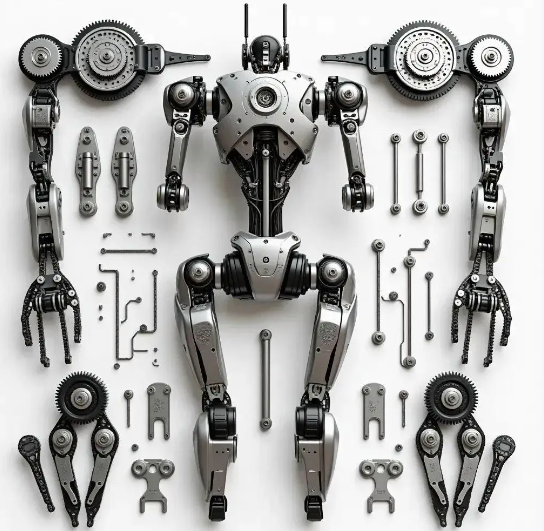
Humanoid limbs consist of interconnected mechanical structures, precision joints, and load-bearing components. Each part must accommodate different movement patterns and mechanical stresses.
Typical Custom Robotic Components include:
● Shoulder and elbow components: Actuator housings, joint brackets, bearing seats, and connecting plates.
● Wrist and hand components: Compact shafts, finger linkages, precision pins, and miniature mechanical connectors.
● Hip components: Structural supports, rotary joint housings, and high-load mounting brackets.
● Knee components: Pivot shafts, reinforced joint plates, bearing housings, and actuator connectors.
● Ankle and foot components: Support frames, transmission connectors, sensor mounting bases, and impact-resistant structural parts.
● Limb connecting structures: Upper-arm links, forearm frames, thigh supports, and lower-leg connecting members.
These components work together to transfer mechanical forces between joints while maintaining accurate alignment and smooth movement.
2. Balancing Structural Strength and Lightweight Design
One of the biggest engineering challenges in humanoid robotics is achieving sufficient strength without adding unnecessary weight.
Excessive limb weight increases actuator torque requirements, energy consumption, and rotational inertia. Therefore, material selection and structural optimization must be considered together.
Recommended Materials for Humanoid Components
| Material | Typical Applications | Main Advantages |
| Aluminum 6061-T6 | Limb frames, support brackets | Lightweight, machinable, corrosion resistant |
| Aluminum 7075-T6 | Hip and knee housings | High strength-to-weight ratio |
| Titanium alloys | Joint shafts, critical connectors | High specific strength and corrosion resistance |
| Stainless steel | Pins, shafts, bearing interfaces | Wear resistance and durability |
| Carbon fiber composites | Arm and leg links | Low weight and high stiffness |
| Engineering plastics | Cable guides, protective covers | Lightweight and design flexibility |
Four Strategies for Improving Strength and Reducing Weight
1. Optimize material distribution: Remove unnecessary material while retaining sufficient thickness around mounting holes, bearing seats, and high-stress regions.
2. Use lightweight structural geometries: Ribbed structures, hollow sections, and carefully designed pockets can improve stiffness without excessive mass.
3. Reinforce critical interfaces: Apply appropriate reinforcement around threaded connections, actuator mounts, and load-bearing joints.
4. Validate structural performance: Use finite element analysis (FEA), static load testing, fatigue evaluation, and dimensional inspection to verify the design.
The objective is not simply to make every component lighter, but to achieve the appropriate balance between stiffness, strength, fatigue resistance, and manufacturing feasibility.
3. Precision CNC Machining for Humanoid Robot Parts
Humanoid robot joints require accurate mechanical interfaces. Misaligned bearing seats, inconsistent mounting holes, or dimensional deviations can affect joint movement, assembly accuracy, and long-term reliability.
CNC machining is suitable for manufacturing complex robotic components with controlled dimensions and repeatable geometries.
Important manufacturing processes include:
● Five-axis CNC machining: Produces complex joint housings, curved structural brackets, and multi-angle mounting features.
● CNC milling: Manufactures actuator supports, limb connectors, and precision structural plates.
● CNC turning: Produces shafts, pins, bushings, and cylindrical joint components.
● Grinding: Improves surface finish and dimensional accuracy on selected functional surfaces.
● Wire EDM: Supports the machining of intricate profiles and precision slots.
Manufacturing quality should be verified through dimensional inspection, material certification, surface evaluation, and appropriate functional testing.
4. Manufacturing Equipment and Production Capabilities
For complex humanoid components, equipment selection directly affects machining flexibility and production consistency.
The following equipment is listed in the Start Precision manufacturing equipment inventory:
| Equipment | Brand and Model |
| Five-axis machining center | DMG HSC 75 linear |
| Vertical machining center | DMG DMC 835V |
| Vertical machining center | Mazak VCN-510C |
| Vertical machining center | HAAS VF3 |
| Horizontal machining center | HAAS EC400 |
| CNC turning center | DMG CTX beta 800 |
| Slow wire cutting machine | Sodick ALN400Gs |
These machines provide different machining capabilities for complex housings, structural brackets, precision shafts, and other customized mechanical parts.
Learn more about five-axis precision machining and manufacturing equipment.
5. How Custom Manufacturing Supports Humanoid Robot Development
Every humanoid robot platform has different joint dimensions, actuator configurations, load requirements, and assembly interfaces. Standard components may not satisfy all these design requirements.
Custom manufacturing helps developers:
● Produce components according to customer CAD drawings and technical specifications.
● Optimize structural geometry for specific movement and loading conditions.
● Integrate multiple mounting features into fewer machined parts.
● Improve dimensional consistency between symmetrical left and right limbs.
● Develop prototypes before moving toward repeatable production.
For additional information about manufacturing services and precision components, visit the Start Precision official website.
Conclusion
The performance of humanoid robots depends heavily on the quality of their limb structures and mechanical interfaces. Carefully engineered Custom Robotic Components combine suitable materials, optimized geometries, precision machining, and reliable quality control.
By balancing structural strength with lightweight construction, manufacturers can help robot developers improve movement efficiency, joint reliability, and overall mechanical performance.
If you are developing humanoid robot arms, legs, joint housings, or customized structural components, contact us to discuss your manufacturing requirements and explore a suitable precision machining solution.
Frequently Asked Questions
Q1: What are the most important structural components of humanoid robot limbs?
Key components include shoulder brackets, elbow housings, wrist connectors, hip supports, knee joint plates, ankle housings, limb links, and precision shafts.
Q2: Which materials are suitable for humanoid robot components?
Aluminum 6061 and 7075 are commonly considered for lightweight structural parts. Titanium and stainless steel are suitable for selected high-load interfaces, while carbon fiber composites can reduce the mass of longer limb structures.
Q3: How can humanoid robot components achieve both high strength and low weight?
Engineers can combine material selection, topology optimization, hollow structures, reinforced mounting areas, and FEA validation to improve structural efficiency without compromising critical load-bearing functions.
Q4: Why is five-axis CNC machining useful for humanoid robot components?
Five-axis machining can produce complex geometries and multiple angled features with fewer setups, helping maintain positional relationships between critical mechanical interfaces.
Q5: Can custom robotic components be manufactured according to customer drawings?
Yes. Custom CNC components can be developed according to customer-provided CAD drawings, 3D models, material specifications, dimensional tolerances, and manufacturing requirements.
Q6: What information should customers provide when requesting a manufacturing quotation?
Customers should ideally provide 2D engineering drawings, 3D CAD files, material requirements, target quantities, critical tolerances, surface treatment specifications, and intended operating conditions.






Add: Building 3No.277 Zhen'an Middle Road, Chang'an Town,Dongguan,Guangdong, China
Tel:+86-769-82855591
Copyright © 2019 All Rights Reserved Dongguan Start Precision Technology Co., Ltd. Tel: +86-769-82855591
Add: No. 277 Zhen'an Middle Road, Chang'an Town, Dongguan, Guangdong, China



 中文版
 English
