
Custom Brass CNC Machining with Wire EDM
Date:2026-11-25Article editor:Starting Point PrecisionViews:79Custom brass CNC machining combined with Wire EDM offers an effective manufacturing solution for components requiring intricate geometries, tight dimensional tolerances, and consistent surface quality. By integrating CNC milling, turning, grinding, and wire electrical discharge machining, manufacturers can produce complex brass parts that are difficult to achieve through conventional cutting alone. This combined approach is particularly suitable for precision industrial components, electrical connectors, custom fixtures, and specialized mechanical parts.
1. Why Combine Brass CNC Machining with Wire EDM?
Brass is widely used in precision manufacturing because of its excellent machinability, electrical conductivity, corrosion resistance, and attractive appearance. However, some components feature narrow slots, intricate contours, small internal radii, or complex profiles that conventional milling and turning cannot efficiently produce.
Wire EDM addresses these challenges through controlled electrical discharges. A continuously fed fine wire removes material without direct mechanical contact with the workpiece.
Combining these processes provides several advantages:
● Complex geometries: Produce intricate outlines, narrow slots, fine openings, and customized profiles.
● Dimensional accuracy: Achieve controlled dimensions through CNC programming, precision positioning, and finishing passes.
● Reduced cutting forces: Minimize mechanical loading during wire cutting, helping protect delicate component features.
● Flexible production: Support prototypes, customized components, and small-to-medium production batches.
2. Our Custom Brass CNC Machining Process
Every project starts with an evaluation of the component drawing, brass grade, structural requirements, and application environment.
Our manufacturing workflow integrates multiple processes to achieve the required geometry and quality.
Step 1: Material Selection and CNC Programming
We select suitable brass grades according to the component's functional requirements. Common options include C36000, C26000, and C37700, subject to material availability and project specifications.
After reviewing the 2D drawings or 3D models, our engineers determine machining sequences, cutting parameters, workholding methods, and critical dimensions.
Step 2: CNC Milling and Turning
CNC milling and turning establish the primary geometry of the brass component.
These operations are suitable for:
● Precision holes and threaded features.
● Circular profiles and stepped shafts.
● Complex pockets and milled surfaces.
● Mounting structures and functional interfaces.
For components with multiple angled surfaces or complicated geometries, five-axis machining can reduce repeated setups and improve positional consistency.
Step 3: Wire EDM for Intricate Features
Wire EDM is introduced when conventional machining tools cannot efficiently achieve the required geometry.
The machine guides a thin conductive wire along a programmed path. Controlled electrical discharges remove material while dielectric fluid helps cool the machining zone and flush away debris.
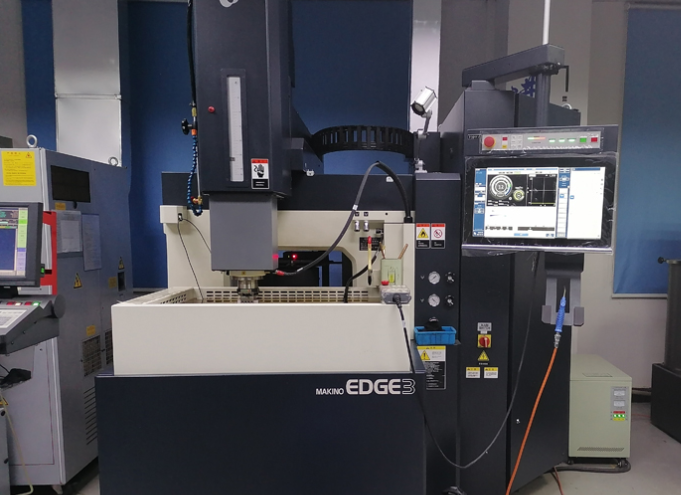
Our precision equipment includes:
| Equipment | Brand and Model | Application |
| Slow Wire Cutting | Japan Seibu M50B | Precision profile cutting |
| Slow Wire Cutting | Japan Sodick ALN400Gs | Intricate contour machining |
| Five-axis Machining Center | Germany DMG HSC 75 linear | Complex 3D geometry |
| Vertical Machining Center | Japan Mazak VCN-510C | Precision milling |
This combination allows us to select the most appropriate process for each feature rather than relying on a single machining method.
3. Manufacturing Complex Shapes with High Precision
One major advantage of custom brass CNC machining with Wire EDM is the ability to manufacture unconventional geometries.
Depending on the drawing and machining conditions, typical features include:
● Narrow and deep slots.
● Complicated internal and external contours.
● Small-radius profile transitions.
● Thin-wall structures.
● Precision holes and customized openings.
● Multi-angle and irregular profiles.
Dimensional control is especially important when several machined features must fit together during assembly. We use drawing-based inspection and appropriate measuring equipment to verify critical dimensions, positional relationships, and geometric requirements.
Actual achievable tolerances depend on material grade, workpiece thickness, geometry, machining parameters, and inspection requirements. Tolerances should therefore be confirmed during the quotation and engineering review stages.
4. Surface Finish and Post-Machining Quality
Surface quality directly affects the appearance, assembly performance, and service life of brass components.
Our finishing strategy is selected according to the final application and drawing specifications.
| Surface Treatment | Main Purpose |
| Precision grinding | Improve flatness and dimensional consistency |
| Deburring | Remove unwanted edges and machining burrs |
| Polishing | Improve surface smoothness and appearance |
| Brushing | Create a uniform directional finish |
| Plating | Provide specified functional or decorative surface properties |
Wire EDM parameters and finishing passes are also adjusted according to surface requirements. For critical applications, we evaluate surface roughness, edge conditions, and dimensional changes after finishing.
5. Quality Control from Prototype to Production
Consistent quality requires more than accurate machine positioning. It depends on material verification, process control, and final inspection.
Our quality approach includes:
● Reviewing technical drawings and critical dimensions before production.
● Checking raw material specifications.
● Monitoring machining conditions and process consistency.
● Inspecting dimensions and geometric features.
● Verifying surface appearance and finishing requirements.
● Conducting final inspections before shipment.
For additional information about our manufacturing capabilities, visit our precision machining and quality assurance page.
6. Applications of Custom Brass CNC Machined Parts
Custom brass components manufactured through CNC machining and Wire EDM can serve various industries:
● Electronics: Electrical contacts, conductive connectors, and precision terminals.
● Industrial equipment: Custom mechanical components, fixtures, and positioning parts.
● Automotive: Specialized brass fittings and precision functional components.
● Instrumentation: Small precision housings, mounting components, and measuring accessories.
The optimal manufacturing route depends on the component's geometry, electrical requirements, operating environment, and production quantity.
7. Work with a Precision Brass Machining Manufacturer
Successful custom manufacturing requires the right combination of engineering knowledge, machining equipment, and quality management.
At Start Precision, we integrate CNC milling, turning, five-axis machining, grinding, and slow-wire EDM capabilities to support complex precision manufacturing projects.
Contact us to discuss your manufacturing requirements. Send us your drawings, material specifications, required tolerances, and estimated quantities. Our team can evaluate your project and recommend a suitable machining solution.
Frequently Asked Questions (FAQ)
Q1: Can Wire EDM machine brass components?
Yes. Brass is electrically conductive and can be processed using Wire EDM. The process is particularly useful for intricate contours, narrow slots, and complex profiles.
Q2: What brass grades can be used for custom CNC machining?
Common options include C36000, C26000, and C37700. The appropriate grade depends on machinability, strength, conductivity, corrosion resistance, and application requirements.
Q3: Can CNC machining and Wire EDM be used on the same brass component?
Yes. CNC milling and turning can produce the primary geometry, while Wire EDM can finish complex profiles and features that are difficult to machine conventionally.
Q4: Does Wire EDM improve brass surface quality?
Wire EDM can produce precise cut surfaces. Multiple finishing passes can improve surface roughness, depending on the material, thickness, and machining parameters.
Q5: What information is needed for a custom brass machining quotation?
Ideally, provide 2D engineering drawings, 3D CAD files, brass material specifications, dimensional tolerances, surface finish requirements, and estimated order quantities.






Add: Building 3No.277 Zhen'an Middle Road, Chang'an Town,Dongguan,Guangdong, China
Tel:+86-769-82855591
Copyright © 2019 All Rights Reserved Dongguan Start Precision Technology Co., Ltd. Tel: +86-769-82855591
Add: No. 277 Zhen'an Middle Road, Chang'an Town, Dongguan, Guangdong, China



 中文版
 English
