Choosing the Right CNC Machine for Machining Parts: A Comprehensive Guide
Date:2026-02-07Article editor:Starting Point PrecisionViews:627Selecting the ideal CNC machine is a critical investment that directly impacts your production capability, part quality, and bottom line. With numerous options available, from 3-axis mills to multi-tasking turn-mill centers, making the right choice requires a structured analysis of your specific needs.
| Machine Tool Type | Core Structural Features | Core Machining Range | Typical Machined Parts | Core Advantages | Applicable Scenarios |
|---|---|---|---|---|---|
| Vertical Machining Center (VMC) | Vertical spindle, 3-axis standard, optional 4th axis with rotary table | Planes, contours, cavities, hole systems, bevels, simple indexing | Mold cores, brackets, motor end covers, non-standard jigs | Easy clamping, good visibility, low fixture cost, stable precision | Single-piece, small-batch; mold and precision parts processing |
| Horizontal Machining Center (HMC) | Horizontal spindle, 4th axis standard, mostly 5-axis, optional pallet changer | Multi-surface machining of boxes, deep holes, complex contours (one clamping) | Gearboxes, engine blocks, hydraulic valve bodies, aerospace parts | Reduced clamping error, high precision, unmanned production available | Mass production; automated lines for high-precision boxes |
| CNC Lathe (Incl. Turning Center) | Horizontal spindle, 2-axis standard, turning center with turning-milling function | Shaft/disc turning, threads, grooves; combined turning-milling (optional) | Transmission shafts, flanges, motor shafts, gear shafts, bushings | High efficiency, good roundness/coaxiality, combined processing optional | Batch production of shafts/discs; single-piece to mass production |
1. Define Your Part Portfolio
The geometry, size, and material of your parts dictate the primary machine type.
(1)Milling Parts (Prismatic): For parts like brackets, housings, or molds with complex 3D contours, a CNC Machining Center is essential.
① Vertical Machining Center (VMC): Ideal for 2.5D to 3D machining on a single face. Perfect for aluminum machining, prototyping, and smaller batch production.
② Horizontal Machining Center (HMC): Superior for heavy, boxy parts requiring machining on multiple sides. Offers better chip evacuation and is often faster for high-volume production.
(2)Turned Parts (Cylindrical): For shafts, pins, and bushings, a CNC Lathe or Turning Center is the starting point. For complex parts requiring both turning and milling features, a Multi-Axis Turn-Mill Center integrates both processes in one setup.
2. Assess Key Machine Tool Specifications
Beyond type, dive into the core specifications that affect performance.
Work Envelope & Table Size: Must accommodate your largest part, plus room for fixtures.
Travels (X, Y, Z): Determine the maximum part size you can machine in one setup.
Spindle Power & Torque: Critical for material removal rates. Heavy stainless steel machining requires high torque, while high-speed aluminum work benefits from high RPM.
Tool Capacity: A larger automatic tool changer (ATC) magazine reduces setup time for complex parts.
Accuracy & Repeatability: Defined by metrics like positioning accuracy (±0.0002") and repeatability. This is non-negotiable for precision machined components.
3. Consider Production Volume & Automation
Your required throughput shapes the machine's configuration.
Low-Volume/Prototyping: A standard 3-axis VMC or benchtop CNC may be sufficient.
High-Volume/Production: Look towards HMCs, pallet changers, and integrated automation like robotic part loaders to maximize uptime.
Job Shop Flexibility: A 5-axis machine, while a higher initial investment, can handle complex geometries in one setup, reducing lead times and increasing capability.
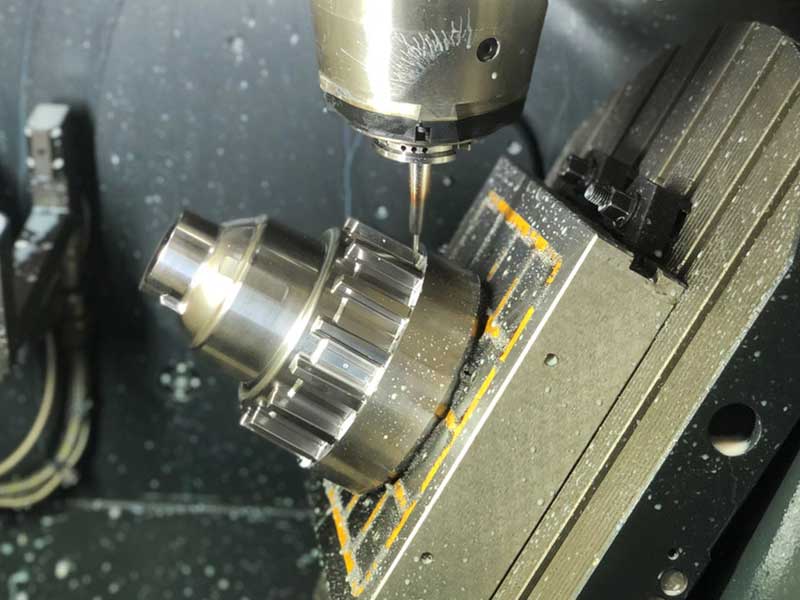
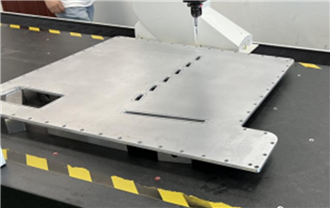
A part being processed by five-axis machining
4. Evaluate the Control System & Software
The CNC controller is the machine's "brain." A familiar, user-friendly interface (like Fanuc, Siemens, or Heidenhain) reduces programming time and operator training. Ensure compatibility with your existing CAM software for seamless workflow from design to finished part.
5. Factor in Total Cost of Ownership (TCO)
Look beyond the initial purchase price:
Installation & Foundation: Some machines require special flooring.
Tooling & Fixturing: Initial outfitting can be significant.
Maintenance & Support: Reliable local technical service is invaluable. Review warranty and service agreements carefully.
6. Selection Checklist:
Part Materials: ___
Maximum Part Dimensions: ___
Critical Tolerances/Surface Finish: ___
Required Daily/Monthly Output: ___
Available Floor Space & Power: ___
Operator Skill Level: ___
Budget (Machine + Tooling + Installation): ___
Conclusion
Choosing the right CNC machine is a balance of technical requirements, production strategy, and financial planning. By meticulously analyzing your part portfolio and production goals, you can select a machine that not only meets your current needs but also offers scalability for future growth. Partner with reputable manufacturers, request test cuts on your actual material, and prioritize robust support to ensure a successful, long-term investment.
Add: Building 3No.277 Zhen'an Middle Road, Chang'an Town,Dongguan,Guangdong, China
Tel:+86-769-82855591
Copyright © 2019 All Rights Reserved Dongguan Start Precision Technology Co., Ltd. Tel: +86-769-82855591
Add: No. 277 Zhen'an Middle Road, Chang'an Town, Dongguan, Guangdong, China



 中文版
中文版 English