IATF 16949 for Automotive Five-axis Machining Technology: Precision and Process Control
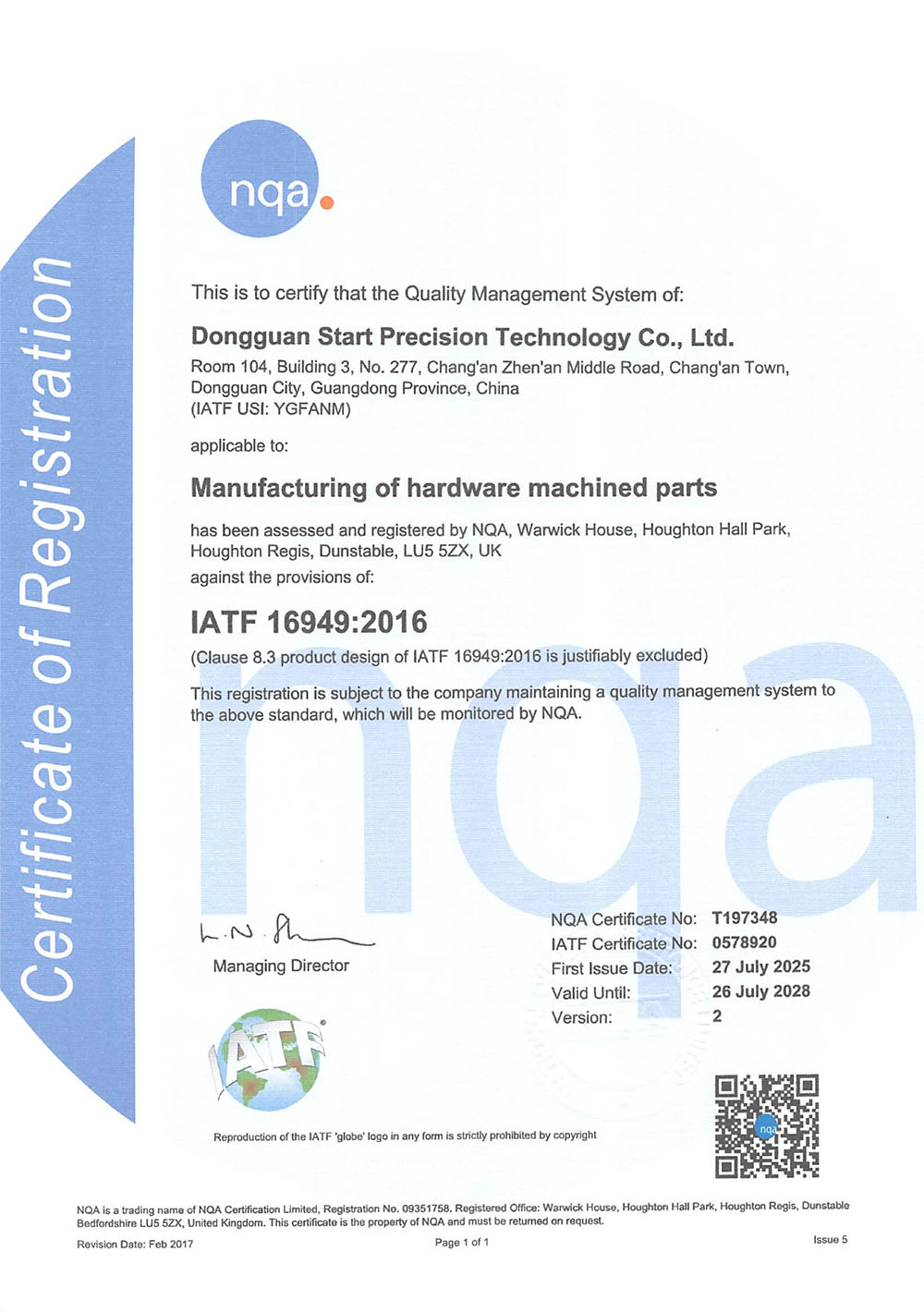
Date:2026-03-18Article editor:Starting Point PrecisionViews:525The automotive industry demands ever-increasing precision, efficiency, and reliability in manufacturing. Five-axis machining technology has emerged as a cornerstone for producing complex components—from engine blocks to transmission housings—with tight tolerances and superior surface finishes. However, the full potential of this advanced technology can only be realized within a robust quality management framework. This is where IATF 16949 plays a pivotal role, ensuring that five-axis machining processes consistently deliver parts that meet stringent automotive requirements.
IATF 16949 is an international standard focused on defect prevention, reduction of variation, and waste elimination in the automotive supply chain. When applied to five-axis machining, it provides a structured approach to managing the unique challenges of multi-axis operations, such as complex tool paths, fixture design, thermal stability, and dynamic balancing. By integrating IATF 16949 principles, manufacturers can transform their five-axis cells into highly controlled, predictable production units.
Process Approach and Risk Management in Five-Axis Machining
A core element of IATF 16949 is the process approach, which emphasizes understanding and managing interrelated activities. In five-axis machining, this means mapping the entire workflow: from receiving raw material and CNC programming to in-process inspection and final validation. The standard mandates the use of core tools like FMEA (Failure Mode and Effects Analysis) to proactively identify potential failures—such as tool deflection, vibration marks, or thermal growth—and implement preventive controls. For instance, a design FMEA might address workpiece clamping issues, while a process FMEA could focus on coolant flow to prevent heat-induced inaccuracies.
Equipment Capability and Maintenance
Five-axis machines are capital-intensive assets, and their precision degrades over time without proper care. IATF 16949 requires documented procedures for Total Productive Maintenance (TPM) to ensure machinery remains in statistical control. Regular spindle analysis, ballbar tests, and laser calibration are essential to verify that the machine can hold the required tolerances. The standard also emphasizes measurement system analysis (MSA) for probing systems and in-machine metrology, ensuring that the data used for process adjustments is reliable.
Training and Human Factors
Despite high levels of automation, human expertise remains critical in five-axis programming and setup. IATF 16949 stipulates competence requirements for personnel. Operators and programmers must be trained not only in CAM software and machine operation but also in understanding the quality implications of their decisions. For example, a programmer must know how toolpath strategies affect surface integrity and residual stress, which are often specified by customers.
Statistical Process Control and Continuous Improvement
Five-axis machining generates complex geometric features that can be challenging to measure. IATF 16949 encourages the use of Statistical Process Control (SPC) to monitor key characteristics. By collecting data from in-process probing or post-process CMM inspections, manufacturers can detect trends—like gradual tool wear—before they produce non-conforming parts. This aligns with the standard's philosophy of continuous improvement (Kaizen). For instance, analyzing SPC data might reveal that a specific axis combination leads to contour errors, prompting a update to post-processor settings or a change in cutting parameters.
Documentation and Traceability
Automotive supply chains require complete traceability. IATF 16949 mandates documented control of production changes, process specifications, and inspection records. For five-axis machining, this includes maintaining records of CNC programs (with version control), tool offsets, and inspection results. If a quality issue arises, the manufacturer must be able to trace the part back to the specific machine, operator, and batch of raw material. This level of traceability is often a prerequisite for supplying Tier 1 automotive companies.
Conclusion
Integrating IATF 16949 with five-axis machining technology creates a synergy that drives excellence. The standard provides the framework to manage complexity, reduce risk, and foster a culture of quality. As automotive designs evolve toward lighter, stronger, and more intricate components, the combination of advanced machining capabilities and rigorous quality management will be the key differentiator for suppliers aiming to compete globally. Investing in IATF 16949 compliance is not just about certification; it is about building a foundation for sustainable precision.
Add: Building 3No.277 Zhen'an Middle Road, Chang'an Town,Dongguan,Guangdong, China
Tel:+86-769-82855591
Copyright © 2019 All Rights Reserved Dongguan Start Precision Technology Co., Ltd. Tel: +86-769-82855591
Add: No. 277 Zhen'an Middle Road, Chang'an Town, Dongguan, Guangdong, China



 中文版
中文版 English