Essential Guide to Low Volume CNC Machining: Strategies for Efficient Fixture Design and Selection
Date:2026-03-09Article editor:Starting Point PrecisionViews:537In the world of modern manufacturing, Low Volume CNC Machining bridges the gap between prototyping and mass production. It allows businesses to produce functional parts in quantities ranging from 50 to 1,000 units without the high costs of permanent tooling.
However, the rules that apply to high-volume production do not always translate well to small batches. One of the biggest challenges lies in workholding. Unlike mass production, where expensive, dedicated fixtures are amortized over millions of parts, low-volume runs require a different mindset. This guide explores the core strategies for efficient fixture design and selection to ensure your next project is both cost-effective and precise.
The Unique Challenges of Low Volume Workholding
When you are only making 100 parts, you cannot justify a $5,000 hydraulic fixture. Yet, you still need to maintain tight tolerances. The primary goals in this phase are reducing lead time on fixture fabrication and maintaining flexibility for design changes.
If a design revision comes through halfway through the run, your fixturing solution must adapt—or be scrapped without breaking the budget. This is where strategic fixture selection becomes more important than the machining process itself.
Strategy 1: The Rise of Modular Fixturing Systems
For general machine shops handling diverse projects, modular fixturing is the gold standard.
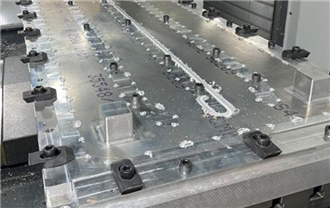
Instead of machining a dedicated block, modular systems use a grid of precision holes and slots with interlocking components (locating pins, clamps, and risers). You can assemble a complex fixture in minutes rather than waiting days for a machined vise jaw.
This approach is ideal for low volume because once the batch is done, you break down the fixture and reuse the components for the next job. The initial investment is higher than soft jaws, but the long-term flexibility for multiple low-volume runs is unmatched.
Strategy 2: Soft and Conformable Jaws
When dealing with irregularly shaped castings or thin-wall parts, standard parallel jaws often fail to provide enough surface contact, leading to deformation.
Soft jaws (usually aluminum or mild steel) are machined in-house to match the exact contour of the part. For low volume, this is a quick win. You can machine a pocket into a soft jaw that nests the part perfectly, distributing clamping pressure evenly.
For extremely delicate or oddly shaped parts, consider conformable jaws that use potted materials or low-melt alloys to create a perfect negative of the part surface.
Strategy 3: Vacuum and Magnetic Workholding
For non-ferrous materials like aluminum or stainless steel, traditional clamps can obstruct the toolpath, requiring multiple setups.
Vacuum Chucks: Ideal for large, flat parts or thin-wall components. They hold the part from the bottom using suction, leaving the top surface completely exposed for 5-axis machining or surfacing.
Magnetic Chucks: Perfect for ferrous materials. They provide strong, distributed holding force without marring the surface, significantly reducing setup time.
These methods eliminate the need for complex mechanical clamps, speeding up the changeover between batches.
Strategy 4: Design for Additive Manufacturing (DFAM) for Fixtures
Sometimes, the fastest way to get a custom fixture is to 3D print it.
Using FDM or SLS technology, you can print complex nested fixtures, soft jaws, or custom jigs overnight. While plastic fixtures may not have the rigidity of steel for heavy roughing, they are perfect for secondary operations (drilling, tapping, inspection) or holding lightweight parts.
This approach aligns perfectly with the low-volume philosophy: fast, cheap, and easily modifiable. If the part geometry changes, you simply reprint the fixture.
How to Choose the Right Fixture
When selecting a method for your next low-volume run, ask these three questions:
What is the lead time? If you need parts tomorrow, modular or soft jaws are likely the answer.
What is the material? Aluminum works well with vacuum; steel works well with magnets or mechanical clamps.
Is there a secondary operation? If you are only drilling holes after machining, a simple 3D-printed drill guide might suffice.
Conclusion
Mastering Fixture Design and Selection is the secret to profitability in low-volume CNC environments. By leveraging modular systems, additive manufacturing, and modern workholding technologies like vacuum chucks, you can slash setup times and deliver high-quality parts faster than competitors relying on outdated methods.

Add: Building 3No.277 Zhen'an Middle Road, Chang'an Town,Dongguan,Guangdong, China
Tel:+86-769-82855591
Copyright © 2019 All Rights Reserved Dongguan Start Precision Technology Co., Ltd. Tel: +86-769-82855591
Add: No. 277 Zhen'an Middle Road, Chang'an Town, Dongguan, Guangdong, China



 中文版
中文版 English